Braking systems
Braking is based on friction. There are no other physical dimensions or forces; it’s just down friction between the brake lining and the drum, or the pad and the disc. And, finally, what brings the brake forces to apply is friction between the tyre and the road. There are two different materials touching each other and providing a certain coefficient of friction, and a braking force results.
Generally speaking, the whole idea of brake control is to try to maintain wheel slip to give a little control, so that you can steer the vehicle. If the wheel locks, you are not able to steer. To avoid that, a control system of the brake tries to prevent complete wheel locking, to retain the ability to steer, but still provide a portion of braking force friction to come through the wheel to the street. This is the main principle of brakes and applies to everything: passenger cars, trucks, trailers, motorbikes and now even bicycles – Bosch has developed ABS for disc brakes on the front wheel of electric bicycles.
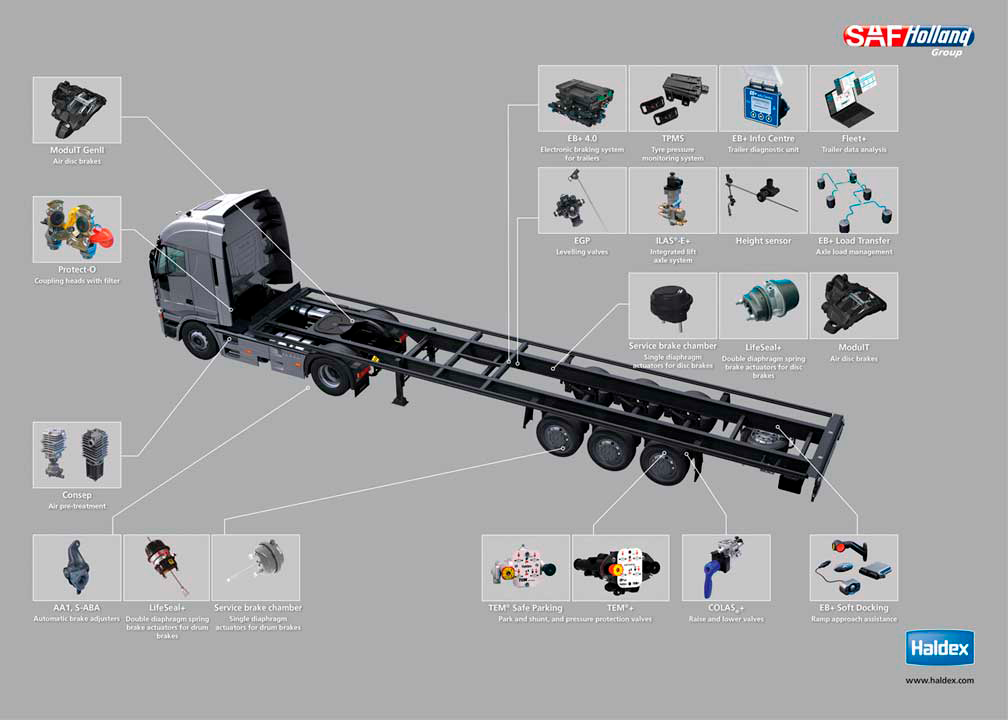
On a bicycle, or in a car, the driver’s physical effort applies the brakes (some vehicles offer a degree of assistance). However, because trucks are so much heavier, up to 40t, there is no means for a human being to generate so much force. Therefore, trucks and trailers use a pneumatic system instead, powered by a compressor. When the driver pushes on the brake pedal, that acts as a signal to brake and used to be transmitted by air in small cross-section piping to relay valves, which passed it on to the actuator, pushed against the piston, which moved a lever on the brake chamber to have provided the force to create friction in the brake disc or drum. The brake adjuster connects the brake drum to a mechanism that automatically expands the linings against the drum as they wear.
In previous systems, if the brakes were to be applied too forcefully, the wheels would lock, and the vehicle will skid. The rate of locking depends partly on the road surface. On a dry surface, 80% of the normal force of a brake can be transferred to friction. If it is wet, that figure reduces to 20%, and if it is icy, that goes down to less than 1%. There is still friction at wheel lock, but the bigger problem is the loss of the ability to steer; inertia pushes the vehicle straight. You can turn the steering wheel, but the vehicle will retain the direction of its initial movement.
To prevent this, antilock braking systems (ABS) came to trucks in the mid-1970s, and to trailers in the 1990s (Modal, 1991; Modular, 1998). They compare the vehicle speed with the rotational speed of the wheel. If the wheel is determined to be locking, or moving slower than the vehicle, ABS releases the brakes for a short period – it does not apply the brakes -- until the two come into sync. This variable is called slip factor. Zero slip means that the wheel is free-spinning; 100% slip factor means that the wheel is locked. Optimal braking and optimal steering require 20-30% slip. To release the brakes, ABS just releases air from the brake chamber. In an ideal world, ABS shouldn’t engage. If you drive gently observing everything in front of you, ABS doesn’t do anything.
A few years later, electronic braking systems emerged for trailers, such as EB+ Gen1 in 2001. Compared to ABS, trailer EBS systems can apply the brakes, and do; in every brake application, EBS is in charge. That happens by receiving an electrical signal for brake application from the tractor unit. The biggest improvement is that there is no lag between the time the brakes receive a signal and are applied. While pressure signals propagate through air at the speed of sound, electrical signals travel at the speed of light. For that reason, EBS significantly reduces stopping distance. An additional solenoid is employed to do this. There is still a relay connected to the air reservoir, which acts as braking energy storage.
Since trailer EBS not only releases the brakes but also applies them, it can also perform strategic applications, for stability control. The system checks speeds – there is an accelerometer in the EBS, and depending on movements, can apply one side of braking early or both sides. That can act to stabilise the trailer when it goes faster than it should.
European regulations only require that trucks and tractors are fitted with ABS and stability control; in fact, EBS is not mentioned. However, the improvements that it brings in performance is so great that no one in Europe runs ABS with stability control; they use EBS instead, which includes electrical brake demand signals, and closed-loop control. This means that EBS applies the brakes and senses the demand and the outcome in terms of pressure in the brake chamber. ABS is an open-loop control; it only checks the vehicle speed and releases the brakes. ABS stability also applies the brake, but is also open-loop; it doesn’t check the outcome.
EB+ Gen2 of Haldex’s trailer EBS came out in 2008; EB+ Gen3 in 2014, and Gen4 (EB+ 4.0) was released in 2020 (but because of COVID only reached the market in 2022). The first system’s body was initially machined from a solid aluminium block, partly because of the low volume of demand in the target market. Later, it was enhanced with an engineering-grade plastic body. With EB+ Gen2, the number of electrically-controlled inputs was enhanced as was the CPU; it went back to aluminium die casting to be more flexible in production.
Now, EB+ 4.0 is trying to cover the greatest number of products in a single platform. It is designed in a modular way so you can equip as many modules as the functional scope needs. A big benefit is weight saving: 2kg, compared to EB+ Gen3. It has more auxiliary functions, including raise and lower, lift axle valves and parking. There is a sophisticated ECU with increased intelligence and computational power. In Gen3, there was a maximum of five different consumers; it has increased up to eight in EB+ 4.0. The amount of computational power has consistently increased over the generations.
Another trend is in increasing connectivity. EBS is the only standardised power source in a trailer; it powers auxiliary functions like Soft Docking or telematics and connects all electrical systems surrounding them, as ambient-temperature trailers aren’t fitted with power. In fact, data and power connections are now combined. In the past, when it was purely ABS, the connector was five-pin. Once trailers switched to EBS in 2001, the standard power cable was extended to seven pins, adding CAN low and CAN high. That is also where EBS gets the brake demand, according to CAN-bus digital communication standard ISO 11992.
In the future, we are looking to go to an electromechanical brake, to save energy. Every brake application loses energy, in that they release pre-compressed air. That pressure is regenerated by a compressor that is connected to the engine, which consumes fuel. Air is an expensive source of energy; everyone is looking to remove it from the truck. Electromechanical brakes, which are currently being developed by Haldex, comprise a full-electric brake-by-wire system that removes the air lines and pneumatic actuators, and replaces them with electric wiring and a wheel-end electric motor that applies force to a brake disc. Despite its technical sophistication, ultimately, however, the system still uses friction for braking, within the brake calliper and drum, and between the tyre and the road.