TEM®+: The complete trailer valve
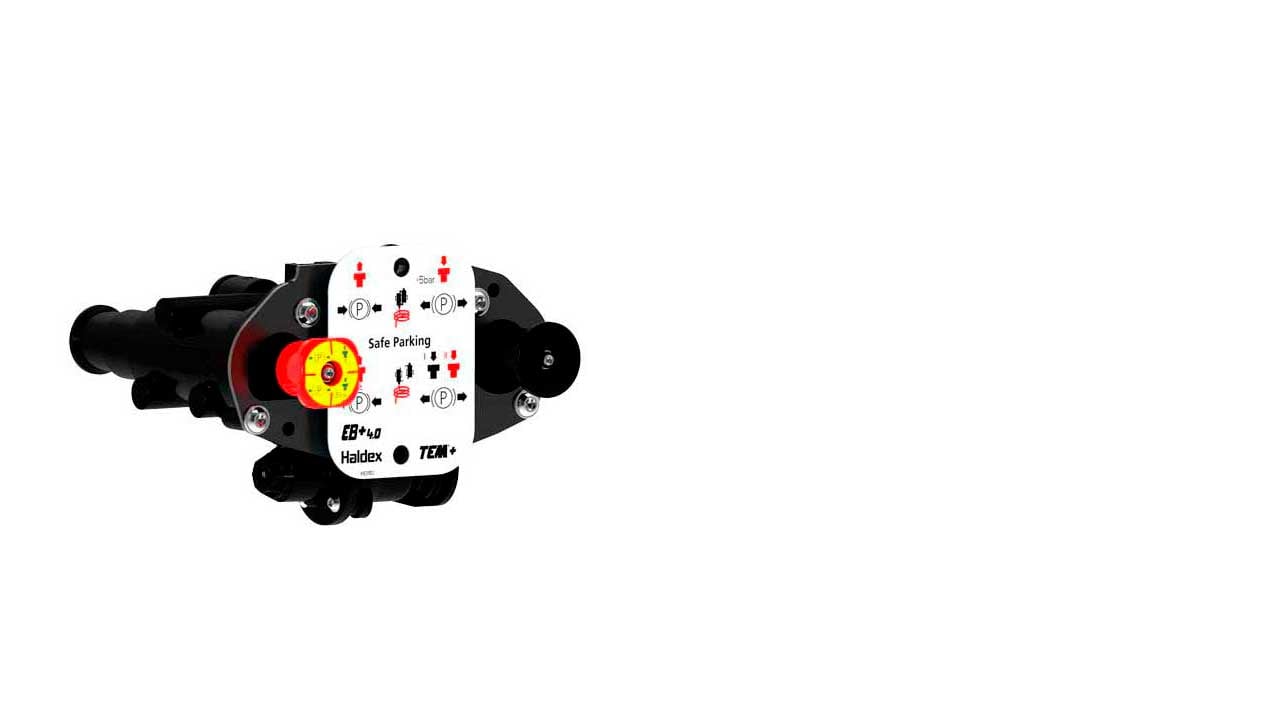
The Haldex TEMâ+ (Trailer Emergency Module) valve control ensures the maximum amount of operational safety for trailers, by efficiently actuating the trailer parking brakes, while at the same time imposing minimal operational complexity on busy drivers.
In contrast to the original TEMâ, the Haldex TEMâ+ has a modular design principle which is based partly around a lightweight, but robust, engineering polymer housing. That means that Haldex now offers a feature set that can be adapted to the needs of individual trailer customers. The optional functions Safe Parkingâ, full trailer valve, and pressure protection valve, offer additional safety features. Some of these are complemented within the modular architecture of the Haldex EB+4.0 EBS electronic braking system.
Haldex’s modular approach maximises both the range of safety features and the ability for customers to have the power to pick and choose which features they want.
Whatever optional features are chosen, all TEMâ+ units provide simple, safe, and effective park and shunt functions, as well as emergency braking, by using valves to direct compressed air stored on the trailer to release or apply the trailer axle parking brakes. The TEMâ+ unit consists of two push-pull knobs: the red left-hand knob (park), and the black right-hand knob (shunt).
This is how the system works:
First, consider the case of moving off. After a driver has manoeuvred the truck’s fifth wheel to engage the trailer kingpin, and connected the yellow (control) line, red (supply) line, and Suzie cables, the tractor’s air compressor will fill the trailer’s system to an operating pressure of about 8.5 bar. Then the driver must leave the cab, walk to the rear of the trailer to the TEMâ+ panel, and press the park brake button. Pushing this manual valve connects the parking spring brake actuator to the compressed air supply, thus releasing the brakes by overcoming their spring force.
When the driver has reached the destination they again leave the cab, walk to the TEMâ+ panel, and pull out the park brake button. This exhausts the spring brake circuit, thus dropping the pressure and allowing the spring force to clamp on the parking brake; then the trailer can be decoupled.
This is also the operating principle of the emergency braking feature: in case of an air leak from a broken pipe, the pressure in the system will drop and the parking brakes will apply automatically. To recover a trailer immobilised due to such a leak, a technician would need to use a caging tool to manually wind up the spring brake actuator. An internal check valve prevents venting the stored compressed air of the brake system.
With the shunt valve, operators can release the brakes to move (shunt) the trailer around the yard without having to connect it to a tractor’s compressed air supply. First, the driver pushes in the shunt valve; that opens the connection from the onboard compressed air tank to the park valve. At the same time it blocks the open connection to the disconnected red line so the compressed air held in the inner circuit cannot escape. Then the driver pushes in the park valve, thus completing the circuit to pressurise the spring brake cylinder and release the brakes. After manoeuvring, the driver should immobilise the trailer by pulling out the parking brake button and the shunt valve button.
Turning to optional features, the Safe Parkingâ valve prevents the risk of trailer rollaway during coupling and uncoupling operations. Specifically, it guards against the situation of a driver attaching a trailer and forgetting to pull out the parking valve on the TEMâ+ panel. If the park valve was left pushed in when the air lines from the tractor were connected, the compressed air from the tractor would pressurise the circuit, releasing the parking spring brake, and potentially allowing dangerous uncontrolled movement of the trailer in the yard.
Instead, within TEMâ+, the Safe Parkingâ valve sits immediately behind the park valve. It is spring-loaded, and that spring force acts to push out the park valve automatically. A ‘pushed out’ park valve does not feed any air to the actuator, so the spring brakes automatically clamp. This feature means that the TEMâ+ is fail safe, keeping the brakes applied when the trailer is being attached to the tractor.
But how are the brakes released? In this scenario, as compressed air pressurises the trailer braking system, a new circuit within the TEMâ+ module opposes the Safe Parking â valve spring force - to a certain extent. Only when the system reaches a defined pressure, it is sufficient to overcome the spring force in the Safe Parkingâ valve to allow it to be pushed in (and stay in). Then, air will flow to the spring brake actuators and release the brakes at 5 bar.
Trailer customers specifying Haldex’s latest electronic braking system, EB+ 4.0, can also choose to integrate a Safe Parkingâ feature in that system - as part of an emergency braking override function option. However, if they are not choosing to specify EB+ 4.0 with the emergency override, Safe Parkingâ might be more cost-effective when integrated into TEMâ+. This is an example of how Haldex provides many options for customers.
A second option in the TEMâ+ system improves the safety of drawbar trailers. Instead of a semi-trailer, which groups all three axles together, a drawbar trailer is supported by an axle in front and one or a pair of axles at the rear. While the front axle may be fitted with a parking spring brake and service brakes, these are not usually braked in an emergency; TEMâ+ would instead apply the parking brakes on one or both of the rear axles. This arrangement can make it harder for a combination to stop abruptly in a stable way. To improve safety, Haldex advises braking on all axles. Therefore, in an emergency, the full trailer option incorporates new air circuits in the TEMâ+ valve bank to direct compressed air from the yellow control line to the service brakes of the front trailer axle.
Finally, TEMâ+ can be configured with or without a pressure protection valve. Trailers that are fitted with air suspension draw on the same supply of compressed air as the brakes to raise and lower the loading deck to suit different loading bays. If the air suspension system leaked it could exhaust the braking system too, causing an unacceptable safety risk to the vehicle and other road users. The pressure protection valve prevents this situation from occurring, by limiting losses to the braking system. The remaining 5 bar of pressure, although reduced, is recognised by European law to be sufficient for braking. Again, trailer builders have the choice of integrating the pressure protection function within the TEMâ+ or integrating it into the EBS+4.0 modulator.
The Haldex trailer air brake system has proven to be simple, robust, reliable, and safe -- over millions of kilometres of driving experience. TEMâ+ continues to offer these values for new trailers in Europe, and globally.