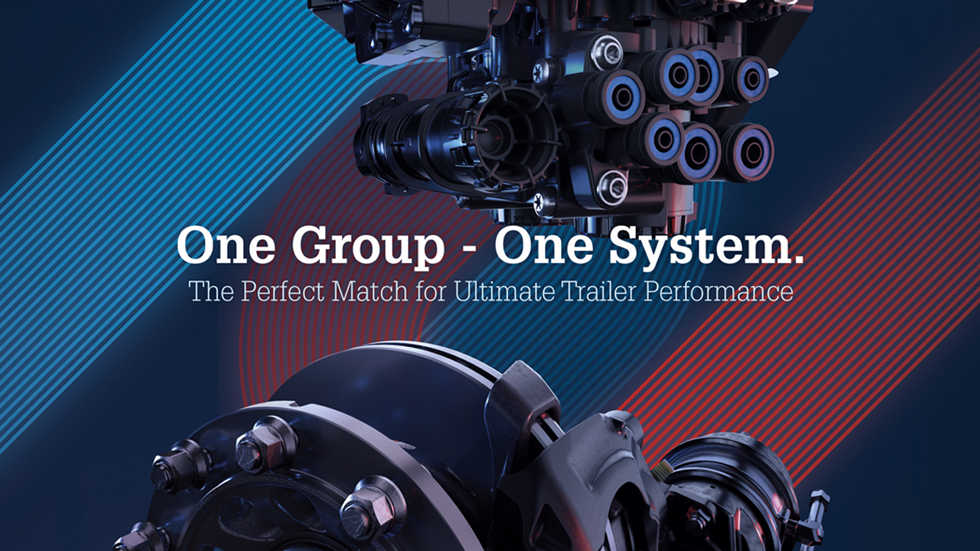
Haldex expands its modern braking system
Haldex, is to further expand into the truck market with its innovative ModulT system gaining its first on-highway truck customer.
Without mentioning the customer by name , it is an important step for the ModulT technology, which was originally developed for trailers in 2011; its single-tappet design offering key advantages in terms of weight reduction and cost-effectiveness.
“Our main goal was to make the lightest trailer brake available,” says Charlotte Wall, vice president of product management at Haldex. “To achieve this, we had to not only reduce the weight on the casted parts, but also minimize the number of parts."
The single-tappet design of ModulT is one of the main features helps with this and it is unique in the market, with Haldex being the only manufacturer offering it for higher brake torques.
"The main reason we are able to make this brake work is the force distribution,” says Mrs Wall. “We have a very wide support mechanism, which applies load onto the thrust plate evenly, creating pressure on the pad. This allows us to stabilize the setup."
This design not only reduces weight but also simplifies the brake system, leading to easier maintenance and lower overall costs for vehicle operators. Other brake manufactures use two tappets to apply sufficient force to the thrust plate, this means more parts and more weight due to the need for a larger calliper.
The expansion of the ModulT system to trucks has required some adaptations. “The difference between trailer and truck brake version is mainly the adjustment function,” says Wall. "If you use the brake on a truck or a bus, the brake spectra – the number of applications on the different torque levels as well as parking brakes – is different compared to a trailer. That's why we need to have a mechanism on the truck brake to manage a more challenging brake spectra. We use a modular design, allowing us to have the same incremental parts in all truck brakes as well as sliding function, while the casted parts and pads are always customized to the wheel size.”
In the future, Haldex aims to continue its expansion into the truck and bus brake markets. However, each new application requires application development work, even when adapting existing brake designs. “There is always a period of time that is required to make those customizations and validations,” says Wall.
This process is rigorous, involving both regulatory validations and customer-specific test plans and can include temperature tests, disc crack tests, lifetime tests, and field tests that often run for 12 months to two years.
While virtual testing plays a crucial role in the development process, particularly for stress analysis of materials, it has limitations in other areas. "You can absolutely investigate stress levels in the materials and so on. But you can't do virtual testing when it comes to the friction couple, as some failures only can be found in the field," says Wall.
"On the road, we might see uneven wear on the pads, for example,” she continues. “Then you have to look at the complete installation and not only the brake, because it's not always the brake that is the issue.”
Wall's extensive experience in the industry – spanning over 25 years at Haldex in various roles from logistics to R&D - has given her a deep understanding of the challenges and opportunities in brake system development. Her current role is to overseeing product and project management for both Haldex and SAF-Holland in Europe (following its acquisition of Haldex).
The ModulT system's expansion into the truck market represents is a significant step forward in Haldex's mission to provide lighter, more efficient braking solutions right across the commercial vehicle industry.