Meeting the safety challenges of modern agricultural machinery
How Haldex braking technology is addressing the demands of increasingly powerful tractors and trailers
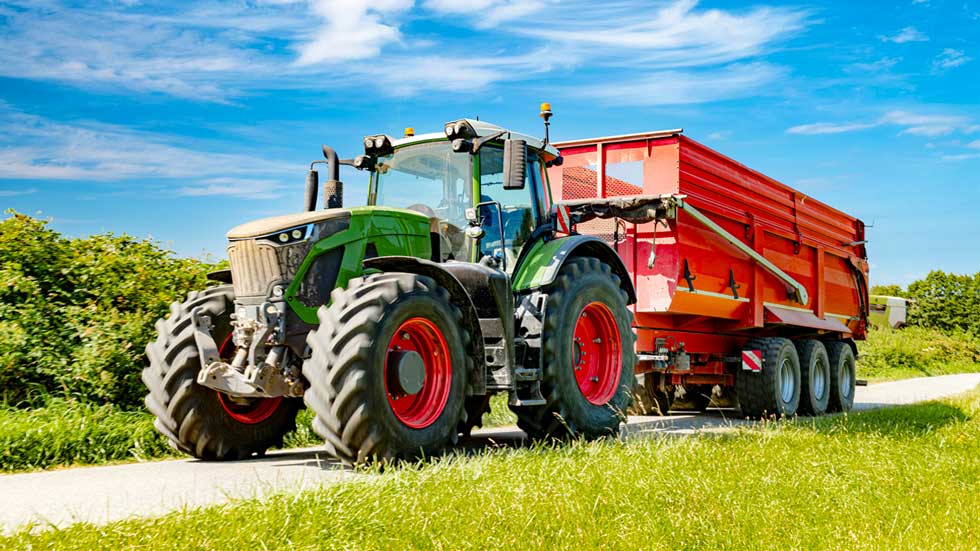
The agricultural industry is experiencing a massive transformation in scale and power. Modern farm tractors now routinely operate with up to 700 horsepower – ten times the capacity of machines from just two decades ago – while trailers can carry payloads of 20-30 tons, up from the 3-5 tons of old. This dramatic increase in size and capability has created new safety challenges that require sophisticated braking solutions.
Haldex, leveraging decades of experience in commercial vehicle braking systems, has developed specialized components for agricultural applications that address these evolving demands. The company's solenoid trailer control valve (STCV) and emergency line restrictor (ELR) represent targeted engineering solutions to the unique challenges of modern agricultural operations.
The growing scale of agricultural equipment
The dramatic growth in the capability and power of agricultural machinery is driven by population growth and the need for food security, as well as increasingly unpredictable weather patterns because of climate change. The agricultural industry faces mounting pressure to maximize productivity. Larger, more powerful machinery enables farmers to work more efficiently and meet these growing demands.
However, with increased scale comes significant safety implications. Operating speeds have increased and Siegfred Heer, senior commercial product manager air controls at Haldex explains that simple farm vehicles have become sophisticated machines requiring professional licensing: "They are now technical vehicles that often require a lot of knowledge to drive and use safely," he says.
The Solenoid Trailer Control Valve
One of the fundamental challenges in agricultural trailer braking systems stems from the hydraulic brake systems commonly used. Whereas commercial trucks use pneumatic systems, tractors typically generate brake signals from hydraulic systems that must be converted to pneumatic signals for the trailer.
The displacement volume of hydraulic brake systems is inherently limited, which restricts the cross-sections of the valves used in the system. This limitation creates a characteristic delay in brake response, particularly affecting the trailer. When a driver applies the tractor brake, the tractor responds immediately, but the trailer experiences a delayed response. This delay might create a dangerous situation where the trailer may push forward and overtake the tractor during braking. Experienced drivers can compensate by initially applying higher brake pressure, then easing off slightly. However, less experienced operators may struggle with this technique, potentially creating hazardous situations.
Haldex's solution is the Solenoid Trailer Control Valve (STCV). Heer explains that the STCV operates independently of the brake pressure in the tractor during the beginning of braking. When the tractor brake is applied and the brake light activates, the solenoid immediately sends a pneumatic signal of around 0.8 bar to the trailer. This pre-signal ensures the trailer begins braking independently and simultaneously with the tractor, eliminating the dangerous delay.
While this initial signal alone would be insufficient for emergency braking situations, the conventional trailer control valve continues to function alongside the solenoid system, increasing brake pressure to the trailer as needed based on the driver's input. This dual-action approach provides both immediate response and full braking capability.
Emergency Line Protection
Complementing the STCV is the Emergency Line Restrictor (ELR), a component mandated by relatively recent legislation in the agricultural sector. The ELR acts in case the yellow signal line that supplies pressure to the trailer fails.
In agricultural trailer braking systems, two pneumatic lines connect the tractor to the trailer: the yellow signal line and the red supply line. If the yellow line fails, the driver typically will not immediately recognize the problem, but a trailer brake loss and a significant air leak will occur during braking. To trigger the emergency braking function, the red supply line must also exhaust its pressure. However, because the red line remains connected to the tractor's air supply tank, exhausting the system would take too long without intervention.
The ELR solves this problem by isolating the tractor tank from the trailer system when a yellow line failure is detected. This isolation dramatically accelerates the exhaust of the red line pressure. Legal requirements stipulate that the red line must exhaust to below 1.5 bar within two seconds, a specification that the ELR is designed to meet.
This emergency function has long been integrated into commercial truck and trailer systems, but agricultural vehicles historically operated at lower speeds – typically below 25km/h with a maximum of 40km/h – and were not subject to the same regulations. The legislation requiring this safety feature in agricultural applications was introduced around eight years ago, an indication of the industry's evolution toward higher speeds and heavier loads.
Technical considerations for agricultural applications
While many principles transfer directly from commercial vehicle applications, agricultural environments present unique challenges. One of the most significant is the exposure to agricultural environment.
Heer says that this challenge requires careful attention to valve surface treatments and material selection. "You must do some additional testing, but it's also based on the selection of material," he says. "Our engineers know which kind of material works with the specific environment."
Installation and system integration expertise
The effectiveness of agricultural braking systems depends not just on component quality but also on proper design and installation. Response time is a critical parameter that must be maintained throughout the entire system, and this requires careful attention to pneumatic line routing.
While Haldex provides components with appropriate response characteristics, excessive use of elbows in pneumatic lines or restrictive pipe sizing can significantly impede pressure build-up and compromise response times.
"If you have a lot of elbows in the pipeline, it will reduce the speed of pressure build-up," Heer says. "In the end, you need to pass a homologation of the complete vehicle. That means the response time needs to be kept."
Heer recommends minimizing elbows and restrictions in both the yellow and red lines. Additionally, installing the ELR near to the STCV reduces pipe lengths and supports optimal response times. Haldex works closely with vehicle builders to achieve the required safety performance.
Leveraging commercial vehicle heritage
Haldex's expertise in agricultural braking systems builds directly on the company's extensive experience in commercial vehicle applications. Technologies can be transferred between sectors – with appropriate adaptations for the specific requirements of each market.
Sometimes, smaller agricultural machinery companies require more technical support than their commercial vehicle counterparts. However, Heer points out that while agricultural braking systems on smaller machines may be relatively simple, they are becoming increasingly sophisticated as vehicles grow larger and legal requirements become more stringent.
The company's long history in braking systems, dating back to its heritage as Haldex before becoming part of SAF HOLLAND group, provides a foundation of accumulated knowledge and proven solutions. This experience enables Haldex to understand not only the technical requirements but also the practical challenges of implementing braking systems in real-world operating conditions.
A focus on agriculture
Agriculture is a strategic priority for Haldex, reflecting both the growing importance of the sector and the technical challenges it presents.
While current products like the STCV and ELR are now well-established in the market, the company continues to develop new solutions. Although specific details of future products remain confidential, Heer suggests that integration will be a key theme. By combining multiple functions into fewer components, Haldex aims to reduce installation effort and cost for vehicle manufacturers while maintaining or improving performance.
Meeting food security demands
Larger, more capable machinery represents a key part of the response to food security challenges, enabling farmers to work more land more quickly and manage larger operations with available labor.
Heer emphasises that Haldex’s role in this industry transformation is to ensure that increased productivity does not come at the expense of safety. "We like to be a part of it and support the need in the market," he says, referring to the company's commitment to developing technologies that enable safe operation of modern agricultural equipment.
Haldex's specialised components for agricultural applications, including the STCV and ELR, represent targeted engineering solutions to the specific challenges of modern farming equipment. These technologies build upon decades of experience in commercial vehicle applications and are adapted to meet the unique requirements of agricultural environments, help ensure that increased productivity is achieved safely.
With agricultural operations forming an increasingly important part of SAF-Holland's Strategy Drive 2030, the company is committed to long-term development and support of this sector, ensuring that as farming equipment becomes more powerful, it also becomes safer.