Installation
- The TrCM is fixed to the vehicle chassis with two/three M 8 bolts.
- The control knobs must be easily accessible.
- Not used ports must be plugged.
- For painting/coating all open ports must be protected to avoid penetration of the paint/coat.
- For fittings / push-in fittings refer to the instructions of the respective manufacturer.
Valve |
Black knob (Shunt Valve) |
Red knob
|
Trailer coupled |
Operation conditions |
Service brake system |
Park brake
|
|---|---|---|---|---|---|---|
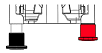 |
pulled | pushed | yes | Drive | released | released |
|
pulled | pushed | no | Trailer uncoupled/braked | Emergency function engaged/released |
Safety function released/engaged |
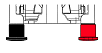 |
pushed | pushed | no | Shunting | released | released |
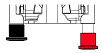 |
pushed | pulled | no | Parking (uncoupled) | released | engaged |
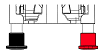 |
pulled | pulled | yes | Parking (coupled) | released | engaged |
|
pulled | pulled | no | Trailer uncoupled/braked | engaged | Released via overload protection valve |
Trailer coupled to the truck
|
||
Id |
Situation |
Description |
| 1 | Supply line connected | With the supply line connected the supply pressure provided by the towing vehicle is available in the braking system without limitation. After oversteps the overflow pressure supply pressure is available also to the additional circuits. |
| 2 | Control line connected | With pressure input through the brake coupling head pressure is passed on undiminished to control port 21 via port 4 (no relay function). |
| 3 | Actuation of parking brake | The spring braking system port 22 is connected with the exhaust port 3 by pulling the red control knob. In this way the pressure in the spring braking system is exhausted and the parking braking system is applied. |
| The spring braking system (port 22) is connected with the air reservoir (port 1-2) by pushing the red control knob. In this way the pressure in the spring braking system is increased and the parking braking system is released. | ||
| 4 | Pressure loss in the supply line | Effect on the service braking system: If the pressure in the supply line falls by at least 1 bar per second, the trailer is automatically braked before the pressure in the supply line has fallen to 2 bar. In addition a direct connection is made between the air reservoir (port 1-2) and port 21.This assures that the automatic braking is provided by the service braking system and hence is ABS-controlled. |
| Effect on the service braking system, Air reservoir and auxiliary equipment: If the supply line (read coupling head) breaks off, integrated non-return valves prevent the supply air from escaping out of the air reservoir of the trailer braking system and –if any- of the auxiliary equipment. | ||
| Effect on the parking braking system: With the parking braking system released (red control knob pushed) the pressure in the spring braking system is maintained by an integrated pressure protection valve until the automatic braking starts; the non-return valve is disabled once the automatic braking is initiated. In this way the same pressure level is established at ports 21, 22, 1-2. With further pressure reduction in the brake air reservoir port 21 and 22 are vented simultaneously, which automatically activates the spring braking system and hence prevents the trailer from rolling away. | ||
| 5 | Pressure loss in the auxiliary equipment | Effect on the service braking system: The pressure loss in an accessory has no direct effect on the service braking system. The braking pressure is guaranteed up to the above-mentioned protection pressure of the pressure protection valve. |
Trailer uncoupled
|
||
Id |
Situation |
Description |
| 6 | Release device service braking system | The shunt valve allows the cancellation of the automatic braking („emergency braking“), triggered by disconnecting the supply line (see EC Directive, annex I, paragraph 2.2.2.11 or ECE-R13, paragraph 5.2.2.11) |
| The automatic braking is cancelled by pushing the black control knob (with the supply line disconnected). This is achieved by disconnecting port 21 from port 12 and connecting port 4 to port 21. | ||
| When the supply line is reconnected and compressed air is made available the shunt valve returns automatically into normal position. | ||
| 7 | Pressure input through the „brake“ coupling head, Supply line not connected: | In the case of pressure input through the coupling head (e.g. with applied parking braking system of the towing vehicle) the brake air reservoir and hence as well the auxiliary equipment with a pressure reduced by the overflow loss are filled. Filling of the auxiliary equipment depends on the pressure protection valve. As a result, an empty / partially filled braking system is already filled before the coupling head of the supply line is connected. |
Inspection
The Trailer Control Module has to be checked for tightness and functions as prescribed (trailer must be locked against unexpected runaway)
- Unpressurised system
Shunt valve (black knob) and parting valve (red knob) must be pushed. - Initial charging (black knob pushed)
With compressed air at port 1 the shunt valve (black knob) must return automatically in to normal operating position. - Automatic emergency braking
Exhaust pressure at port 1 to 0 bar then the emergency braking must react by delivering pressure from the trailer reservoir to port 21. - Pressure protection valve
Refer to the instructions part no: 000 314 012. - Parking valve (red knob)
With the compressed air at port 1 pull the parking valve (red knob) port 22 must exhaust (via port 3) the spring braking system.